



Focus on Gender Bosnia and Herzegovina is a series of publications addressing specific areas of work on gender equality in Bosnia and Herzegovina. It is designed to give more insights on specific gender equality issues and proposed actions to policy makers, experts, governmental institutions, civil society organizations and representatives of international community.
View online/download
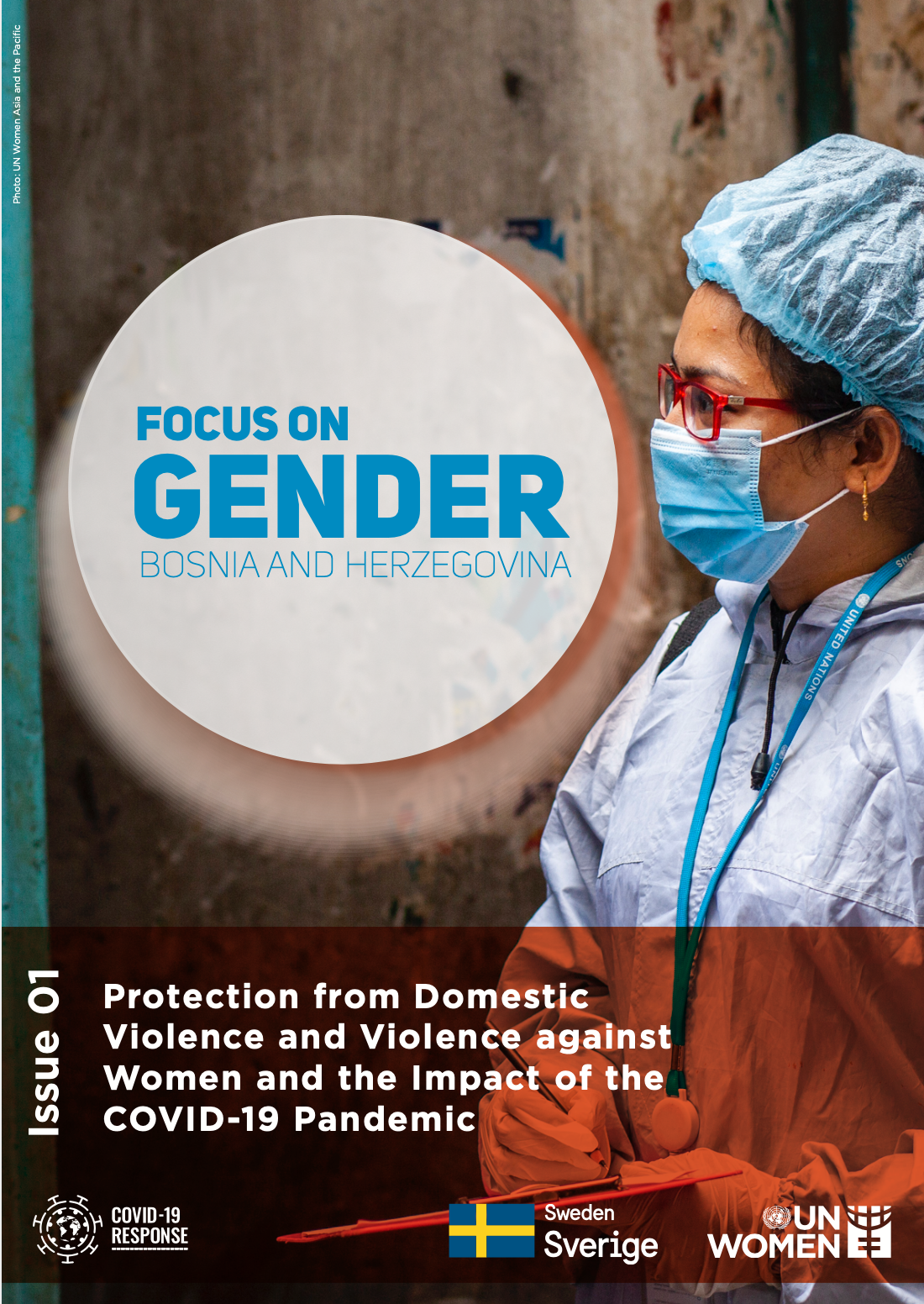
- Issue 01: Protection from domestic violence and violence against women and the impact of the COVID-19 pandemic (English, Bosnian/Croatian/Serbian) – August 2020
The first issue was prepared as a reflection on the available response mechanisms to domestic violence and violence against women with a special focus on the impact of the COVID-19 pandemic in Bosnia and Herzegovina.
- Issue 02: Gender in agriculture and rural development and the impact of the COVID-19 pandemic (English, Bosnian/Croatian/Serbian) – October 2020
The second issue, prepared on the occasion of International Day of Rural Women, concentrates on the gender aspects in agriculture and rural development in Bosnia and Herzegovina, with an additional perspective on the impact of the COVID-19 pandemic.
- Issue 03: Rapid gender assessment of COVID-19 in Bosnia and Herzegovina (English, Bosnian/Croatian/Serbian) – December 2020
The third issue concentrates on the gender aspects of the COVID-19 pandemic in Bosnia and Herzegovina, focusing on how women’s and men’s lives have been impacted and changed in the face of COVID-19, through showcasing results of the Rapid Gender Assessment of COVID-19 in Bosnia and Herzegovina.
- Issue 04: Women’s political participation and leadership in Bosnia and Herzegovina (English, Bosnian/Croatian/Serbian) – April 2021
The fourth issue focuses on women’s political participation and leadership in Bosnia and Herzegovina and provides a brief overview of the relevance of women’s political participation and situational analysis in terms of the legal and policy framework, electoral system, and barriers to political participation of women.
- Issue 05: Gender-Responsive Budgeting in Bosnia and Herzegovina (English, Bosnian/Croatian/Serbian) – December 2021
The fifth issue of Focus on Gender aims at both presenting an overview of UN Women BiH's most recent initiatives on gender-responsive budgeting and providing clarity about the concept and potential of GRB in promoting gender equality and women’s empowerment. Particular attention is devoted to the gender-responsive budgetary analysis of the BiH governments’ measures to mitigate the consequences of the COVID-19 pandemic.
- Issue 06: Sexual violence against women in Bosnia and Herzegovina (English, Bosnian/Croatian/Serbian) – December 2021
The sixth edition of Focus on Gender gives an overview of the main challenges in terms of the legislation, the availability of services for survivors of violence and attitudes toward sexual violence among both men and women. It outlines a set of recommendations that primarily target decision-makers in an attempt to ensure that all forms of sexual violence are condemned, adequately prosecuted and that all survivors have equal access to support services
- Issue 07: Gender Equality Perspective in the EU Accession Process (English, Bosnian/Croatian/Serbian)
The seventh edition of Focus on Gender gives a brief overview of the European Union funded project, Gender Equality Facility, which aims to support the country through the role and functioning of the gender equality structures and mechanisms in aligning to the European Union gender equality acquis. Finally, the publication will present recommendations on how to further improve different segments related to gender equality in Bosnia and Herzegovina.
- Issue 08: Tax and gender in Bosnia and Herzegovina: Is personal income tax gender blind? (English, Bosnian/Croatian/Serbian)
The eighth edition of Focus on Gender zooms in on personal income taxation, with a sex-disaggregated quantitative analysis on the usage of personal allowances during the period 2016 – 2020 in the Federation of Bosnia and Herzegovina and Republika Srpska. The data analysis on the beneficiaries of personal allowances confirms that they are primarily used by men, therefore increasing their disposable income, while also implicitly reinforcing existing gender gaps in the labour markets and family dynamics.
Order printed/published version
Order from
Masha Durkalić, Communication Associate, UN Women in Bosnia and Herzegovina, Zmaja od Bosne bb, 71000 Sarajevo, Bosnia and Herzegovina
Bibliographic information
Geographic coverage: Europe and Central Asia Bosnia and Herzegovina
Subject areas: Access to justice and legal protection Anti-violence interventions COVID-19 Health care services Laws, legislation Shelters Women’s rights
Resource type(s): Briefs Policy papers
Publication year
2020
Number of pages
9
Publishing entity/ies: United Nations Entity for Gender Equality and the Empowerment of Women (UN Women)